The Name That Would Not
Spell Itself Normally
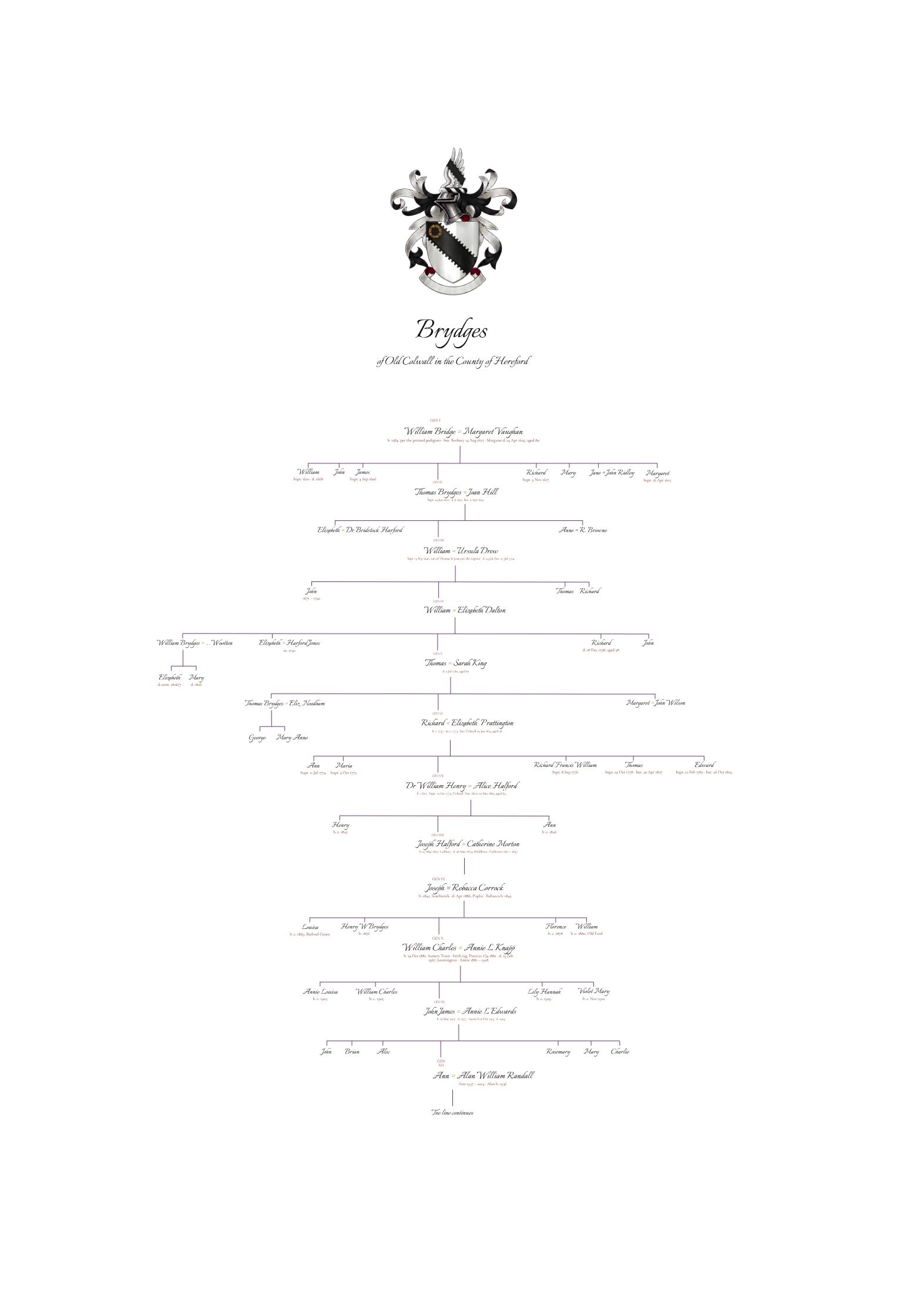
Eight chapters, a prologue and an epilogue, in historical order: from a Tudor farmhouse under the Malvern Hills to a London terrace.
- PrologueA grandmother’s stories
- Ch. OneSet in stone
- Ch. TwoThe borrowed coat
- Ch. ThreeThe house under the hill
- Ch. FourThe trial of the name
- Ch. FiveThe doctor
- Ch. SixThe clue in a middle name
- Ch. SevenSmoke and river
- Ch. EightWhat remains to be found
- EpilogueFour centuries and more
A grandmother’s stories
Every family history starts with a question, and this one starts with my grandmother. Ann Randall was born Ann Brydges in 1937, married Alan William Randall, and died in 2014. With her the surname passes out of this descent — her brothers carried it on — and the line traced here continues as Randall. She would often tell the stories she had been raised on: that the family could trace its heritage back to the Norman Conquest — and that there was a scroll of pedigree, much cherished, to show for it. Those stories, and that scroll, are where my own interest in genealogy and heraldry began. This history is what that interest found.
It found something stranger than the legend. The documents are real, and they run back more than four hundred years — through a doctor, a sheriff, a deathbed will, a baronet who took the family’s name after four years as envoy in Persia, a woman carved in stone at her prayers, and one of the great disputed peerage claims of Georgian England. But they do not run to the Conquest, and they do not run through the grand house the legend pointed to. The first clue was hiding in the name itself: Bridges with a y is an unusual spelling, and unusual spellings are rarely accidents — at some point, somebody chose it, and the choice was kept through every register and census that followed.
Who chose it, when, and why is answered in the chapters below — and the answer makes this the story of a family deeply interested, for three centuries and more, in the history of the wrong family tree; and of the truer, better-documented story that was standing underneath it all along. It is told in historical order, from a Tudor farmhouse under the Malvern Hills to a terrace in Victorian London.
Set in stone · Bosbury and Upleadon, to 1704
The story begins at Bosbury, in the east of Herefordshire, with the family already solid: you can put your hand on them. In the churchyard of Holy Trinity stand two chest tombs, once ringed with iron railings that carried the family’s arms, their Latin inscriptions recorded by the county archive. They belong to the two generations that made everything after them possible.
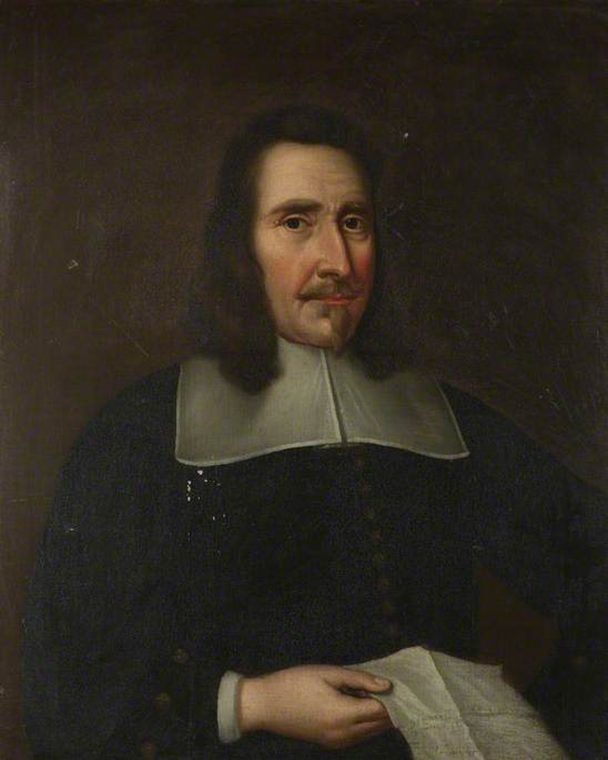
The first tomb holds Thomas Brydges, gentleman, who died on 6 April 1692 — at eighty-nine, says the stone; the baptism register, now read, shows him christened on 24 June 1610, an old man of eighty-one whose tomb added years to him — and who lies, the stone says, near the remains of his father William Brydges, gentleman. That father is the head of the whole line: William Brydges of Upleadon in Bosbury, born — the printed pedigrees say — in 1584, in the reign of Elizabeth I, died 1627. A Latin memorial inside Bosbury church adds what the tombs do not: Thomas was the fourth son of William and Margaret — and the baptism register bears it out exactly: the eldest sons first, then James in 1606, Elizabeth in 1608, Thomas — the fourth son — in 1610, Margaret in 1615 and Richard in 1617, all christened at Bosbury.
The founder’s own testament survives twice over, and both versions can now be read. In May 1619, “William Bridges of Upleadon… gentleman” made his will: burial in Bosbury churchyard under “a broad stone a foot and a half above ground”, an annuity of £16 for Margaret with her chamber over the parlour, portions for eight children — the sons William, John, James, Thomas and Richard, and a peck of corn for every poor householder of the parish. Eight years later, in the spring he died, he made a second will, proved at Canterbury that November (TNA PROB 11/152): the same wife, the same five sons, the daughters Mary and Jane now married to a Northen and a Ridley, and the same two overseers — his brother-in-law John Vaughan, and “my cousin Thomas Lawrence, Esquire”. He was buried at Bosbury on 14 August 1627. Neither version names his father; but the charity of coats and corn that his grandson would endow in 1704 had its pattern set here, at the head of the line.
And then there is the most arresting monument of all, and it belongs to a woman. William of Upleadon’s widow, Margaret, spent her last years at Larport Court at Mordiford, where the Lugg meets the Wye. On 14 April 1655, aged eighty, she died kneeling in prayer — and her family commissioned a tomb in Mordiford church that shows her exactly so, kneeling forever, with an inscription that spells it out:
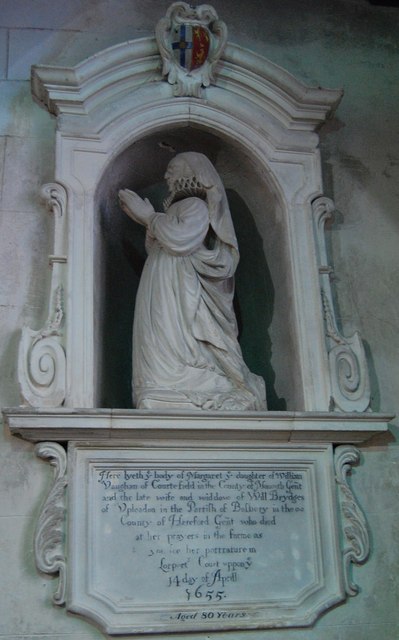
The same stone settles a question the printed pedigrees left open: Margaret was the daughter of William Vaughan of Courtfield in Monmouthshire, where Burke’s had made her the daughter of her brother John — and William of Upleadon’s own will, made in 1619, agrees with the stone, naming “my loving brother in law John Vaughan”. Courtfield was one of the great recusant houses of the Welsh Marches, a family that clung to the old Catholic faith through a century of persecution and would, much later, give England a cardinal. Whatever Margaret herself believed, her marriage ties this family, in its very first generation, to that house.
Consider what passed over these lives. William was born under Elizabeth I. His son Thomas, baptised in 1610, was in his early thirties when the Civil War came through Herefordshire — a royalist county, its city besieged, armies foraging through exactly these lanes — and past fifty when the King came back. Margaret’s death at her prayers in 1655 fell under Cromwell’s Protectorate, when the Prayer Book she had grown old with was officially banned. And the younger William, born 1640, came of age at the Restoration — the moment the family took its fashionable new spelling. No family paper says how they weathered the war; that they came out of it rated top of the parish in 1663 says it plainly enough.
How substantial were they by then? The militia assessments of 1663 answer precisely: in Upleadon the two highest ratings, £100 apiece and more than double anyone else’s, fell on the absentee grandee Sir Robert Pye of Temple Court — and on “William Bridges, esquire”. (An assessment of estate for the militia charge, not a bill — the point is the bracket.) Top of the parish, and note the clerk’s spelling: in the official record of 1663 the fashionable y had not yet stuck.
The second tomb holds Thomas’s son William, the first of the family styled of Old Colwall, and it tells a story in a single date. His will, which survives at Kew, is dated 23 July 1704. His tomb records that he departed this life on 23 July 1704, aged sixty-three. Will and death share a date: he made his will on the day he died. The will names his wife Ursula and three sons; the tomb names four, “William, John, Thomas, Richard — four pledges of mutual love”.
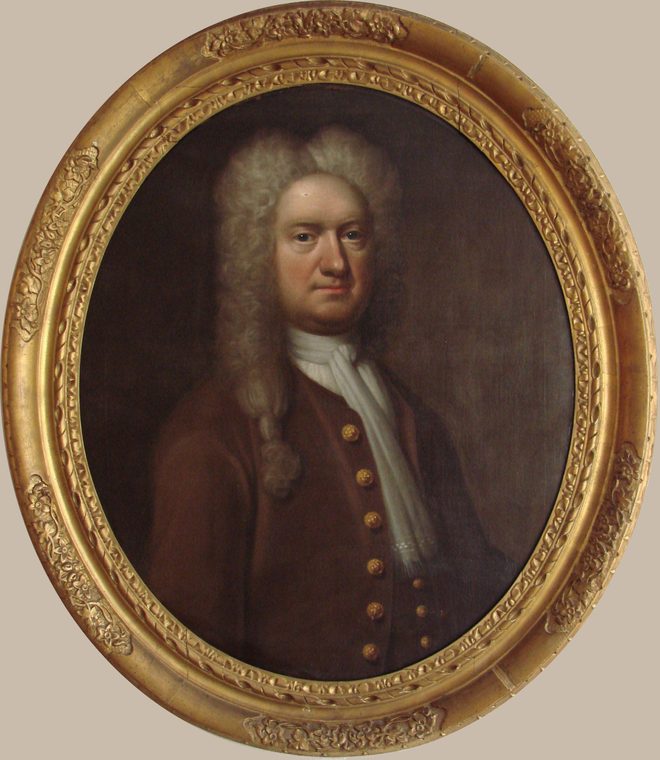
Those sons scattered the family outward in exactly the way gentry families did. William took Old Colwall and married a London merchant’s daughter from Pall Mall. John went to London and the law, rising to Treasurer and Senior Clerk of New Inn, one of the old Inns of Chancery; his memorial inside Bosbury church, carved by the fashionable Worcester sculptor Thomas White, says he “acted with much equity and justice”. Richard, the fourth name on the tomb, is very probably the “Richard Bridges, citizen and mercer of London” who surrendered a Bosbury copyhold in 1707, three years after his father’s death. The gentry of a small county, it turns out, were never only in the county.
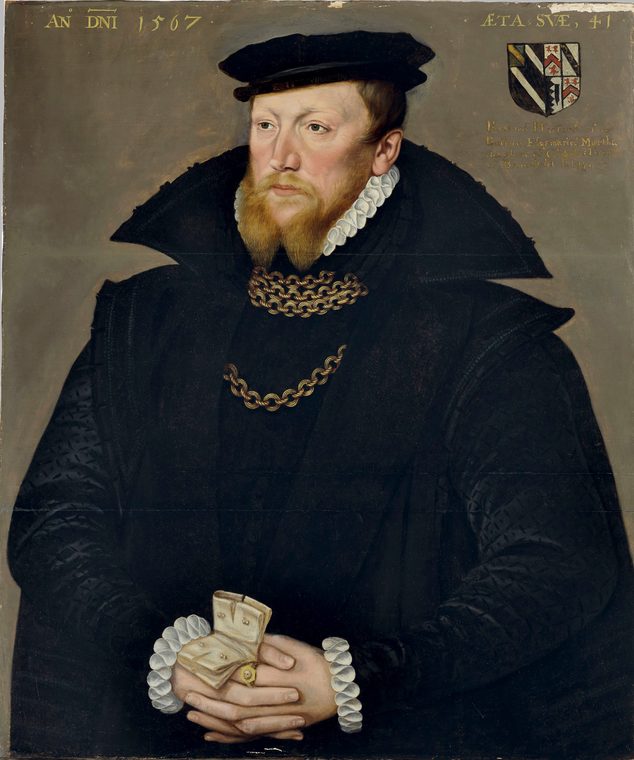
No record states William’s trade, but the documents let the rise be watched. If James Brydge of Ledbury was his father — the case for it is weighed in Chapter Eight — the starting point was a yeoman’s inventory of £72; William’s own will of 1627 disposed of some £1,100 in portions, besides the Upleadon estate, property at Ashperton, and property at Hanley Castle across the Malverns. The instruments are in the wills themselves: stock, corn and implements — a working farmer’s goods — accumulated through the great price inflation of 1560–1620, the classic age in which substantial farmers grew rich on rising markets while rents lagged behind.
The openings were local. Upleadon’s demesne — “the temple of Upleadon”, once the Knights Templar’s — was in a gentleman’s hands in Butterfield’s survey of 1578; and the Mutlows, whose widow that same James married in 1571 — she was the relict of William Mutlowe of the Woodhouse, Ledbury, whose will cost her her widow’s estate if she remarried — were a clan spread from Ledbury to Upleadon itself: the connection, probably, that drew the family the three miles from Ledbury into Bosbury. Add a wife who was an esquire’s daughter, a “cousin” among the Lawrences, gentlemen of Ledbury, and a grant of arms purchased late in life, and the sequence is the common one of the age: profit, then land, then gentility.
The borrowed coat · 1662–1683
Now for the mystery of the spelling — because it was, precisely, a choice. The family had always been Bridge, or Bridges, as the parish clerks wrote it. Then, early in the reign of Charles II, they began writing Brydges — Beltz dates the change to the 1660s. Brydges, with the y, was the spelling used by one of the grand names of England: the Brydges family of Sudeley Castle, Barons Chandos, later Dukes. The motive is not on record, but the accompanying fact is: the family also began displaying the Chandos coat of arms, to which they had no established right.
England has had an official heraldic civil service since 1484: the College of Arms, whose officers grant and police coats of arms to this day. They come in three ranks. At the top sit three Kings of Arms — Garter, the senior; Clarenceux, whose province is England south of the Trent, Herefordshire included; and Norroy, with the north. Beneath them are six heralds bearing ancient titular names (York, Lancaster, Somerset, Richmond, Chester, Windsor), and beneath those four pursuivants, the apprentice grade. Only a King of Arms could grant arms — which is why William’s grant came from Richard St. George, King of Arms. And between 1530 and 1688 the Kings of Arms or their deputies periodically rode circuit through the counties on Visitations, summoning every family displaying arms to show their right: prove it and be entered; fall short and be respited for further proof, or publicly disclaimed. The 1683 Visitation of Herefordshire was the last ever held there.
In 1683 the bill came due, with a symmetry worth noting: the Visitation was held under the authority of Sir Henry St George, Clarenceux King of Arms — grandson of the Richard St. George who had granted the family’s true arms sixty years before. His officers summoned every armigerous family in Herefordshire to prove its right to the arms it displayed. The family Beltz names is the senior branch, the Brydges seated at Tyberton — the line of the founder’s eldest son — “and in that neighbourhood”, which is where Old Colwall lies. They produced the arms of Chandos, he writes, “though with another crest, with the distinction of the second son of the fourth house”. That last phrase is worth unpicking, because it is the whole claim in five words. English heralds mark younger sons with small charges — a crescent for a second son, a martlet for a fourth — and compound them to show a descent: a crescent upon a martlet says the second son of a fourth son. The family had not simply helped themselves to a great name; they had worked out exactly which cadet of it they meant to be.
And this is where the claim falls apart before the herald even speaks. John Brydges, first Baron Chandos, died in 1557 leaving five sons: Edmund, who succeeded him; Charles of Wilton, from whom the later barons and the dukes came; Anthony; Henry; and Richard of North Cerney. To take the difference of the fourth house was to claim descent from Henry — and Henry, on Beltz’s own pedigree of the family, died on 24 January 1615 sine prole, without issue, and was buried at Avening in Gloucestershire. If that is the right reading of the mark, and it is the natural one, then the family had chosen a place in the Chandos pedigree that nobody had ever occupied. Then the herald looked at it, and wrote into the record the sentence that settled the matter:
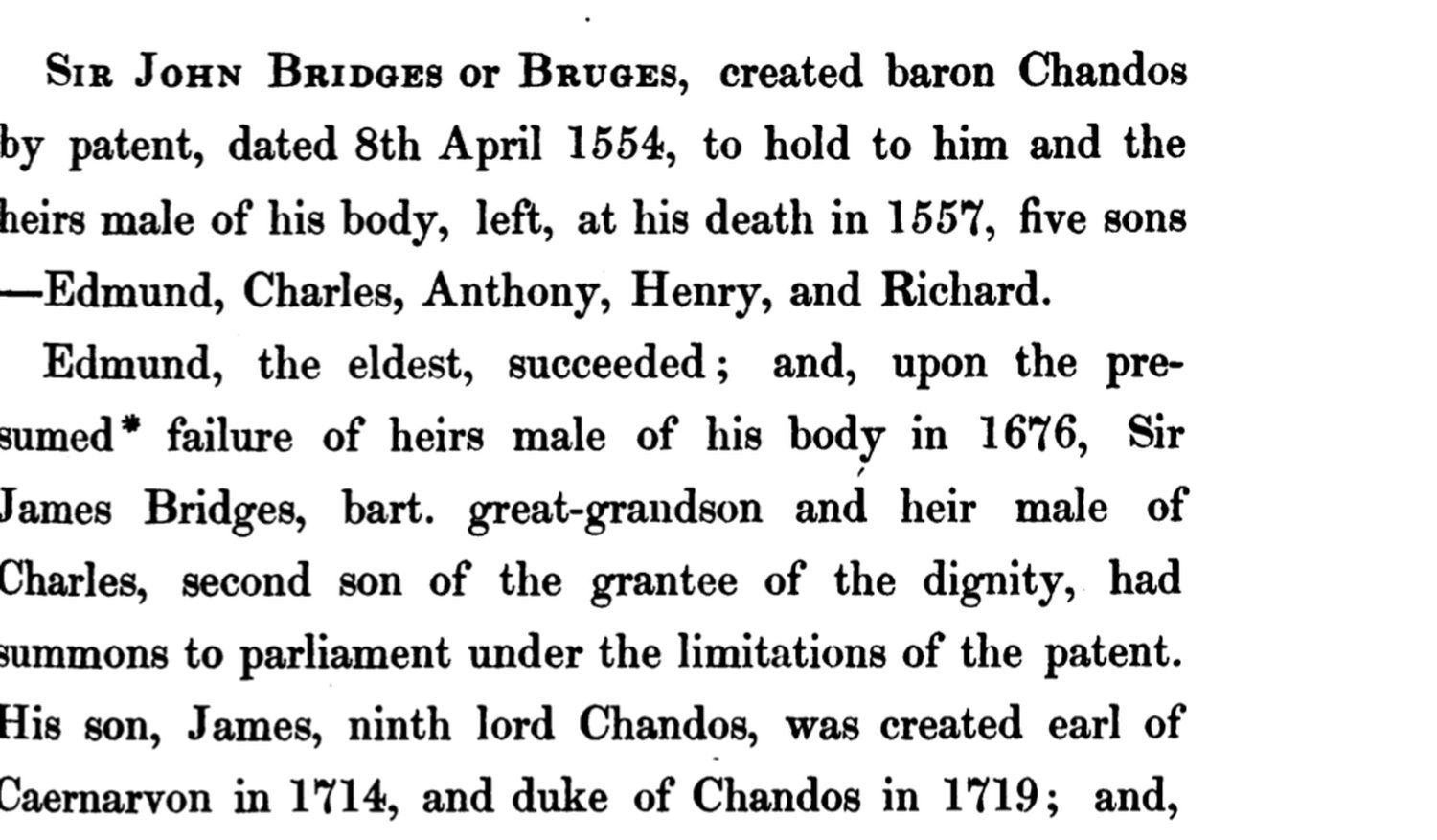
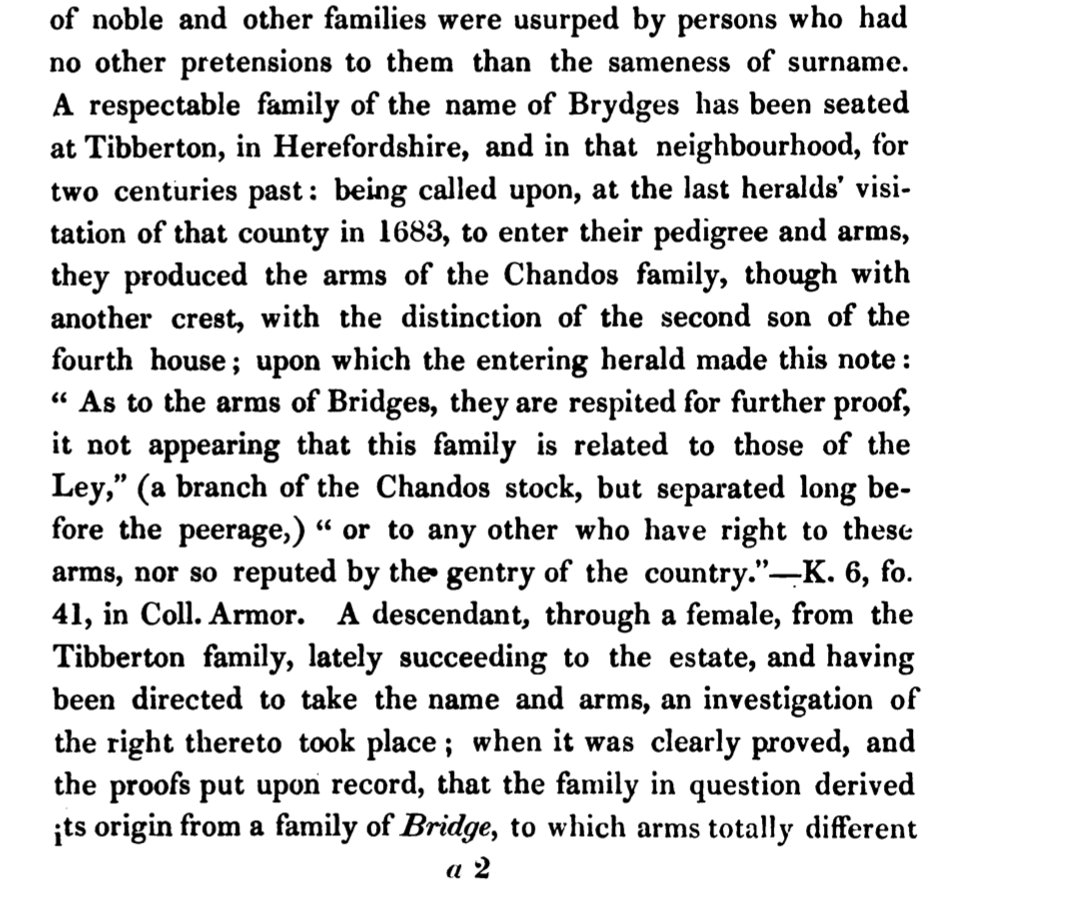
The Ley, Beltz explains in an aside, were “a branch of the Chandos stock, but separated long before the peerage” — the oldest genuine cadet line, and the one place a Herefordshire connection might have been found. It was not theirs either. So the claim failed three times over: the branch they marked themselves as had died childless, the older branch they might have belonged to disowned them, and their neighbours did not believe a word of it. Nor were they alone in trying. A century later the Kent claimants sealed with a mullet, the third son’s mark, for Anthony — and the Lords rejected that too. Nor so reputed by the gentry of the country. Their own neighbours did not believe it. And the herald had spotted the detail that gave the whole game away: above the borrowed Chandos shield, the family were displaying a different crest — their own. You cannot inherit your shield from one family and your crest from another. The crest they actually used belonged to a real grant of arms — and we now know exactly whose. Foster’s index of early grants records it: “Bridge, William, of Bosbury, co. Hereford, by R. St. George” — William of Upleadon himself, the founder of this line, granted his own honest coat late in the reign of James I, in the last years of his life. His shield was argent, on a bend engrailed sable a chaplet of gold; his crest was the very one his grandsons went on wearing above the borrowed Chandos coat — and it too is now recovered: two wings addorsed argent, each charged with a bend engrailed sable, on the exterior bend in the chief point a chaplet or. The coat, in other words, was painted again on the wings above it. That is what the herald of 1683 saw, and what gave the family away. As a later herald put it with some relish, they had worn the wrong hat on the stolen coat, “as if to preserve the means of the more readily detecting the usurpation”.
A century and a half later the question was formally settled. When a descendant through the female line succeeded to the Tyberton estate and was directed to take the name and arms, the College of Arms investigated the whole matter, proved the family’s true origin from the Jacobean grant to Bridge, and exemplified — formally confirmed — the ancient Bridge coat and crest to the name of Brydges. The man who received them was Sir Harford Jones, created a baronet in 1807 and envoy to the court of Persia from that year until 1811, who took the additional name of Brydges by royal sign manual on 4 May 1826. The printed baronetages record what he bore afterwards, and it is worth reading slowly, because the Bosbury coat is in it. The shield is quartered: in the first and fourth quarters, for Brydges, argent, a chief gules, over all a bend engrailed sable charged in the chief point with a chaplet or — the founder’s coat, now with a chief above it; in the second and third, for Jones, a chevron between three crows, and on a chief of augmentation the royal arms of Persia, given him by Fateh Ali Shah and confirmed by royal warrant in 1810. The crests are ranked the same way: first, for Brydges, two wings addorsed argent, each charged with the bend engrailed and its chaplet; then, for Jones, the royal crown of Persia on a cushion, and a crow resting its claw on the star of the Order of the Crescent. A lion and a wyvern hold the shield up, and the motto beneath — Deus pascit corvos, God feeds the crows — puns on the Jones birds.
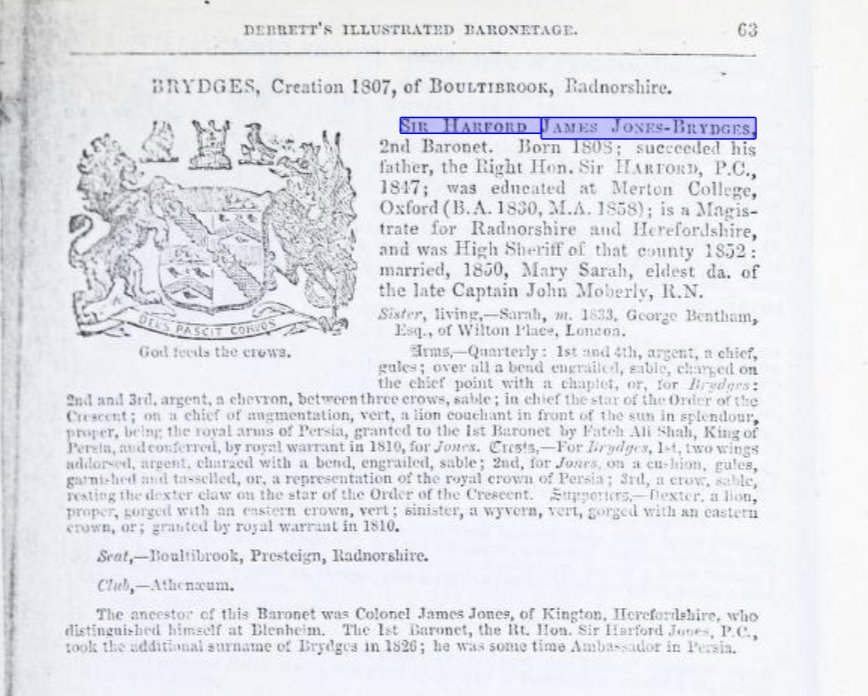
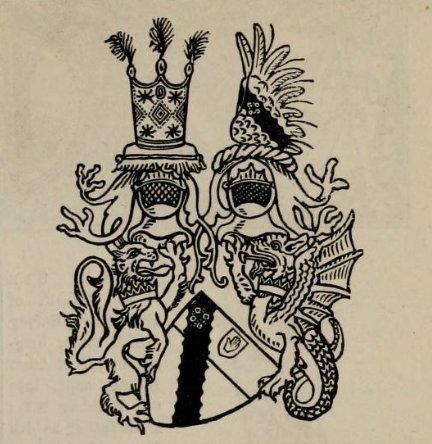
So the wings the herald saw in 1683 outlasted the pretension by a century and a half, and were still being quartered, crowned and blazoned in Debrett’s in the age of the telegraph — first quarter, first crest, ahead of Persia. The verdict, in the end, was double-edged: not Chandos — but genuinely armigerous all along, under the honest coat their own founder had been granted in person, two generations before the pretension began.
The unique spelling that started this whole investigation is a piece of Restoration social climbing, adopted in the 1660s and defended ever since. The family legend of noble Chandos blood is dead — the heralds killed it in 1683 and buried it in the 1820s. But underneath it sits something better than a legend: a real Jacobean grant of arms, two manor houses, a sheriff, and four hundred years of documents. The pretension was borrowed. The gentility was not.
The house under the hill · Old Colwall in its glory
The eighteenth century found a small estate below the Malverns and a family at the height of its standing. Thomas Brydges of Old Colwall served as Sheriff of Herefordshire — the Crown’s senior officer in the county, the man who attended the judges, ran the elections and kept the gaol. For a family of their size it was the summit of provincial life.
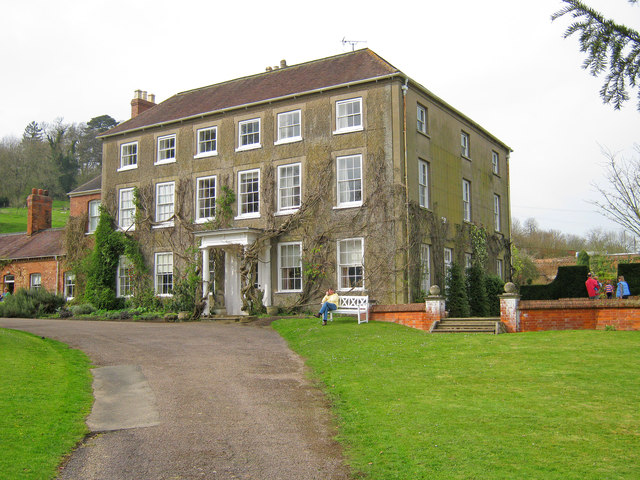
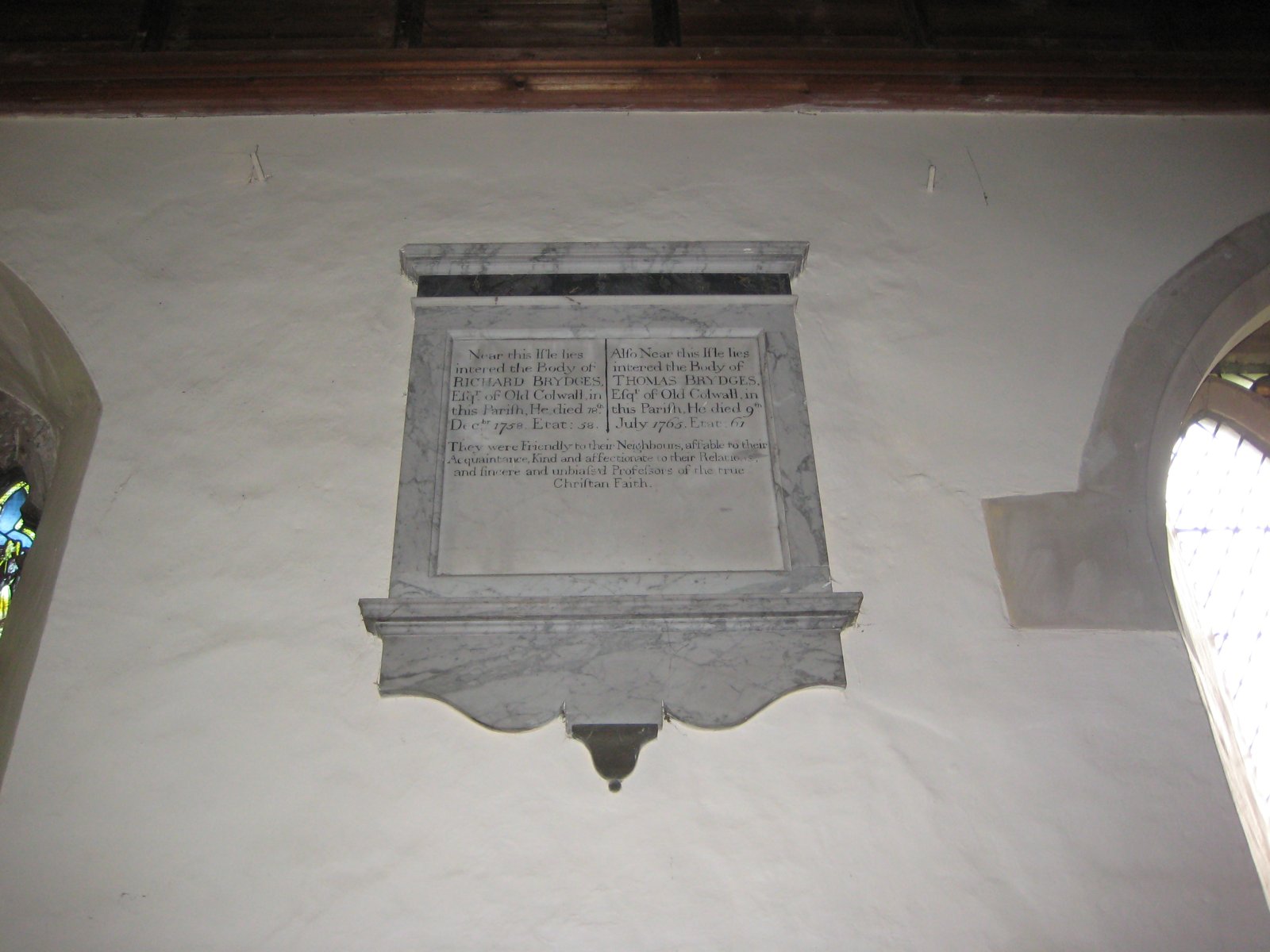
Thomas and the generation around him are commemorated in Colwall church itself. A marble tablet on the nave wall reads: “Near this Isle lies interred the Body of Richard Brydges, Esqr., of Old Colwall in this Parish. He died 18th Decbr 1758, ætat. 58”, and beside it, “Also near this Isle lies interred the Body of Thomas Brydges, Esqr., of Old Colwall in this Parish. He died 9th July 1765, ætat. 61.” Matched against the pedigree, Thomas, born about 1704, is the Sheriff himself; Richard, born about 1700, his elder brother, who died unmarried — which places the younger Richard, Elizabeth Prattington’s husband, as the Sheriff’s son. Beneath the two inscriptions the family added a joint epitaph:
Sums from here on carry a very rough present-day equivalent in brackets, based on the Bank of England’s inflation measure and heavily rounded. Purchasing power is only half the story: set against the wages of the day, when a farm labourer might earn £20 to £30 in a year, every figure below was larger in life than the bracket suggests.
Thomas’s son Richard — born about 1755, by the burial register’s reckoning — married Elizabeth around 1773 and kept the estate; six of their children were baptised at Colwall between 1774 and 1782. (The printed pedigrees give his marriage to Elizabeth Prattington as 1748, a date the register series cannot be reconciled with; the dating followed here, Richard about 1755 and Elizabeth about 1754, fits every record.) With the estate came a family obligation then already two generations old. William’s will of 1704 had doled money to the poor of six parishes and settled £200 (very roughly £35,000 today) on trustees to clothe, “yearly upon St Thomas’ day”, the poor, aged and labouring people of Bosbury in coarse cloth, hose and shoes. The charity ran for over a century, and in 1774 it produced a document of rare genealogical value: a receipt, found by the Charity Commissioners among the Old Colwall estate papers, in which Richard acknowledges the charity capital — £150, roughly £26,000 today — in his own words:
Four generations, confirmed by the man in the middle of them. Richard’s “great grandfather” is William of the 1704 will; the chain from that deathbed will down to Richard is therefore proven not by a printed pedigree but by Richard’s own signature. The receipt also fixes his uncle, William of London and Ledbury, as a woollen-draper, and mentions a Rev. John Brydges, clerk, dead by 1774, as the previous trustee.
In the late 1780s, the county records show the family at their broadest reach and their most absent: the chief landowners of both Bosbury and Upleadon were Brydges — Richard leasing the great tithe from the Bishop of Hereford, his kinswoman Mary Brydges at Old Court carrying Bosbury’s highest land tax assessment — yet none of them living in the parish.
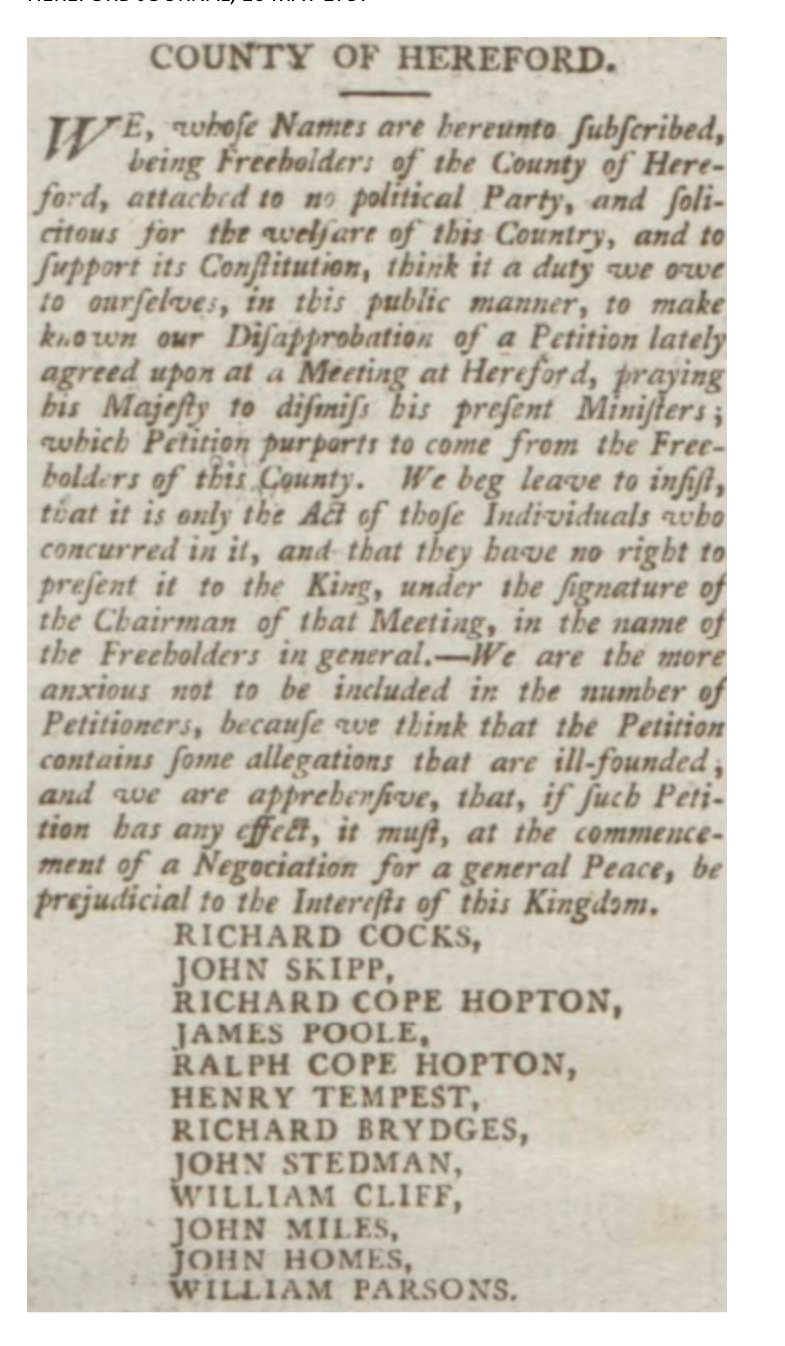
Richard appears once, too, in the county’s public life. On 10 May 1797 the Hereford Journal carried a declaration by twelve freeholders — “attached to no political Party, and solicitous for the welfare of this Country” — disowning a petition lately agreed at a meeting in Hereford, which had prayed his Majesty to dismiss his present Ministers. The petition, they insisted, was “only the Act of those Individuals who concurred in it”, who had no right to present it “in the name of the Freeholders in general”; worse, if it took effect it might, “at the commencement of a Negociation for a general Peace, be prejudicial to the Interests of this Kingdom”. Seventh of the twelve signatures, among the Cockses, the Cope Hoptons and the Skipps, stands Richard Brydges. The spring it was written into was an anxious one: the Bank had suspended cash payments in February, a French force had come ashore in Wales the same month, and the fleet at Spithead had spent April in mutiny. The signature is very probably our Richard — a Herefordshire freeholder of the right name at the right date — though the notice itself says no more than the name.
Richard was buried at Colwall on 29 January 1813, aged fifty-eight, and after his death Old Colwall was sold, passing in March 1827 to James Martin. The sale conditions still listed the family’s standing obligations — twelve coats, twelve pairs of stockings and twelve pairs of shoes for twelve poor men of Bosbury each year, weekly loaves for Colwall and Coddington — and though arbitration first relieved the new owner of them, Martin settled the dispute in 1842 with £150 of capital (about £17,000) and fifteen years’ interest. After some two hundred years, the family and the house had parted; the charity, remarkably, had not finished. Eight Bosbury men received coats from it in 1891, and its successor fund was still distributing St Thomas’ day vouchers in 1984 — two hundred and eighty years after William signed his will and died.
Back in Richard’s own generation, the family had spread beyond Old Colwall. His sister Margaret married John Wilson of Barnard’s Green in Malvern; his elder brother Thomas settled in Malvern. And a cousin, another Elizabeth, lived at Ledbury with her sister Mary, holding stock in the old South Sea annuities — and on 28 August 1804, with the Rector of Pixley among her witnesses, she made one of the most revealing documents in the whole family record: her will.
It survives at The National Archives, and it names, one by one, the people and the parishes she meant to provide for. Three hundred pounds (call it £27,000) to “my cousin Richard Brydges of Old Colwall”. Five hundred pounds (some £45,000) in trust for Richard’s children. An annuity for his sister Margaret. And then the public bequests: bread, bought quarterly forever, for the poor widows of Bosbury and Colwall, “those to be preferred who do not receive parish pay”; one thousand pounds (about £90,000) to found a school for the poor children of Ledbury, with a schoolmistress who was to walk them to church twice every Sunday; five hundred pounds towards new pews in Ledbury church; gifts to the Hereford and Worcester Infirmaries.
Then, on 1 December 1806, describing herself as “still of sound mind and memory tho’ extremely ill”, she added a codicil — and one bequest stands out across two centuries. To George Thomas, “the black servant”, she left an annuity of thirty pounds a year for life — about £2,700 a year now, though the truer measure is that it matched a labourer’s entire annual wage, paid every year until he died — adding a hope that he would not leave her sister “suddenly or unhandsomely”. Parliament abolished the slave trade the following spring; her will was proved on 17 June 1807, three weeks after a boy named Joseph Halford Brydges was born in the same town — a birth this history will come back to.
The trial of the name · 1790–1834
The borrowed coat had a strange afterlife — though it is worth saying at once that this next episode is not, strictly, about this family at all. No Brydges of Bosbury or Old Colwall was party to it, called in it, or so much as mentioned in it. They earn their place because the man who wrote it up needed an illustration, reached for their cousins, and in doing so printed the one record of the 1683 rebuke that survives. Everything we know about that day comes from this book. In 1789 the last Duke of Chandos died without a male heir, and a Kent clergyman, the Reverend Edward Tymewell Brydges, claimed the ancient barony of Chandos, alleging descent from a lost younger son. His brother — Sir Egerton Brydges, bibliographer and genealogist — drove the claim through the House of Lords for thirteen years, and pressed it in print for the rest of his life.
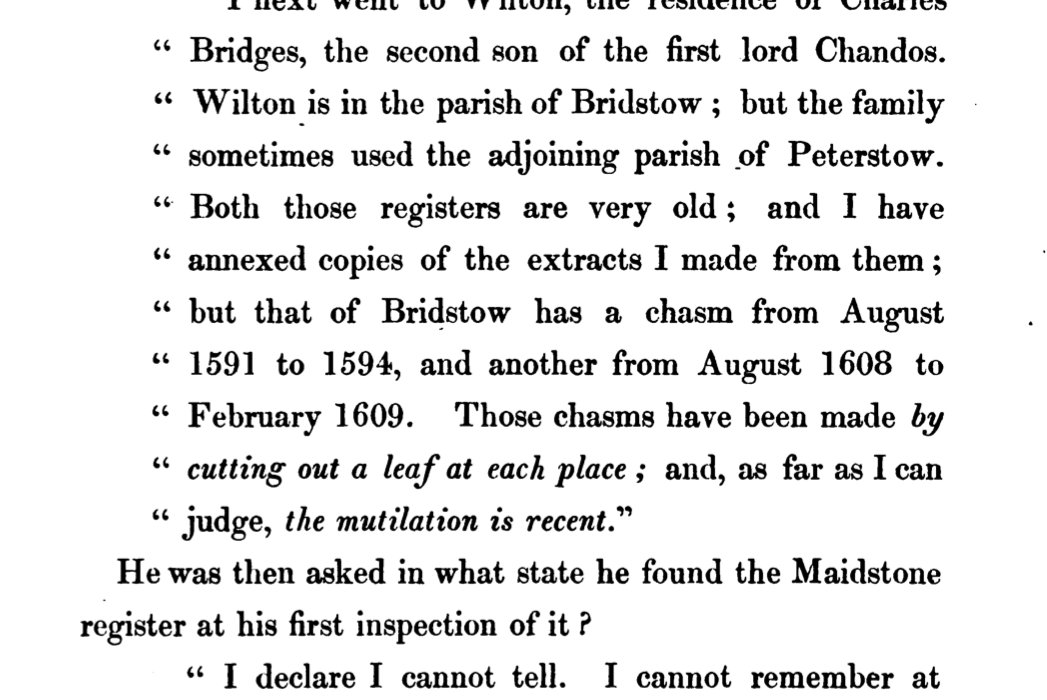
The Crown’s investigators fanned out across England. In 1791 a herald’s agent searched the registers of Gloucestershire and Herefordshire — the Chandos family’s “native counties”, where no trace of the claimed ancestors could be found. At Bridstow, the parish of the Chandos house at Wilton, he found something else. The register, he deposed, “has a chasm from August 1591 to 1594, and another from August 1608 to February 1609. Those chasms have been made by cutting out a leaf at each place; and, as far as I can judge, the mutilation is recent.” Someone had been at the parish books with a knife.
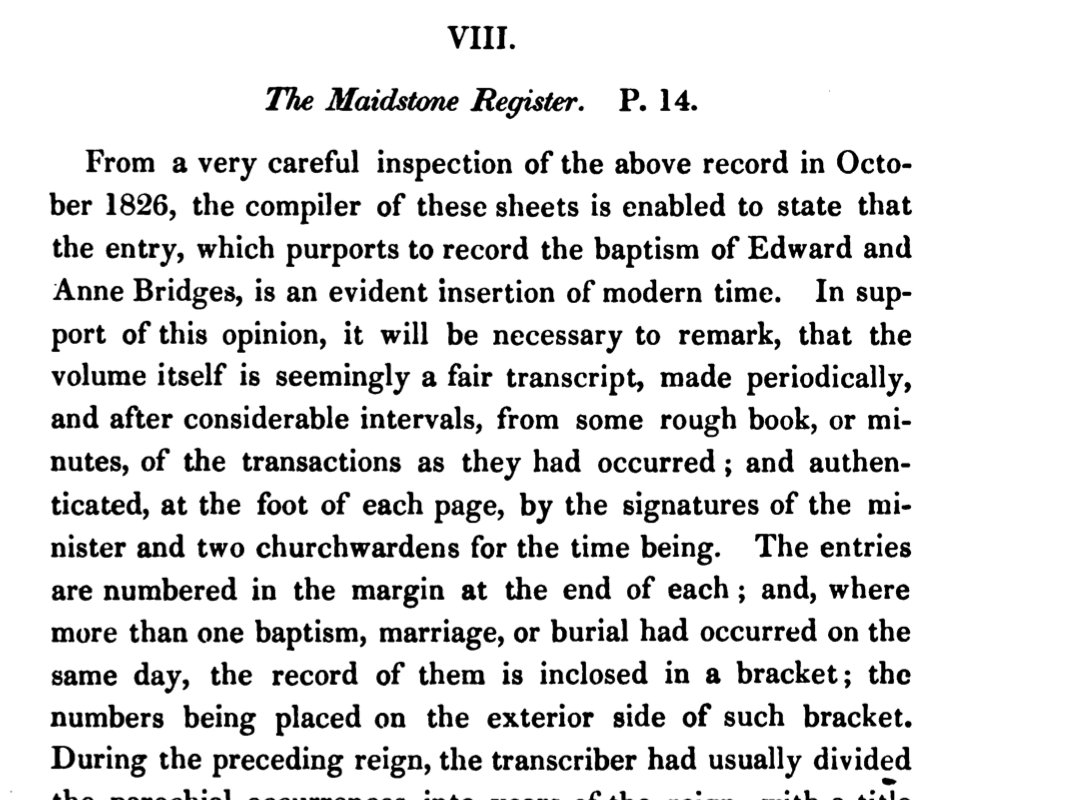
The Lords rejected the claim in 1803. And in October 1826 Beltz went to Maidstone and examined, for himself, the register entry on which the whole descent had rested — the baptism of an Edward and Anne Bridges in 1603. His verdict is flat: the entry “is an evident insertion of modern time”, interlined at the foot of the year in fresher ink, crowding the words that closed the year’s registrations. The claim had been supported, in other words, by a forgery. Sir Egerton styled himself “per legem terrae Baron Chandos of Sudeley” to his dying day anyway — a style he took on his own authority, not Beltz’s account.
In 1834, George Beltz, Lancaster Herald — Lancaster being one of the College’s six ancient herald titles, the office not the man — published his post-mortem of the whole affair — and needed an example of how families borrow grand arms on no better ground than a shared surname. He chose the Brydges of Tyberton — this family’s senior branch — laying out the 1683 rebuke in full. It is a strange sort of immortality: the family appears in the literature of English heraldry as the textbook case of the very thing they did — and it is only because Beltz wanted the example that the herald’s sentence of 1683 was ever printed at all. Read from outside, it is a cautionary tale about a Kent family’s forgery and a Herefordshire family’s pretension. Read from inside this line, it is something narrower and more useful: the accident that preserved the evidence, and pointed the way to the real grant of arms — made not to the cousins at Tyberton, but to the founder of this line himself.
The doctor · Colwall, 1779–1863
Dr William Henry Brydges was born on 1 December 1779 in the parish of Colwall, on the western flank of the Malvern Hills, and died in Herefordshire on 13 March 1863, aged eighty-three. His life spans the distance from the American Revolution to the opening of the London Underground. He married Alice Halford, born about 1781, and their son was born in Ledbury, four miles from Colwall.
A country doctor of William Henry’s generation practised without anaesthetics (ether arrived in 1846, when he was sixty-six), without germ theory (antiseptic surgery came two years after his death), and with few effective medicines beyond opium, quinine and vaccination — the one genuinely modern tool he had, Edward Jenner having published his smallpox work from neighbouring Gloucestershire in 1798. What a doctor offered was availability on horseback, bone-setting, midwifery, and judgement. It was nonetheless a gentleman’s profession, entered by apprenticeship and hospital walking, and for a third son of a landed family — his elder brothers were Richard Francis William and Thomas — it was a respectable berth at precisely the moment the land itself was about to go.
He was a son of the house under the hill — the fifth of Richard and Elizabeth’s six children, baptised at Colwall between 1774 and 1782 — and the register proves it.
For most of this research, one link in the chain stood unproven: who was the doctor’s father? The answer sits in the Colwall baptism register, transcribed by a parish register volunteer: “12 Dec 1779 · William Henry · Brydges · Richard · Elizabeth · Esquire.” Eleven days after his birth, William Henry was carried to the font of St James the Great as the son of Richard Brydges, Esquire, of Old Colwall, and his wife Elizabeth. The same register gives his five siblings, baptised between 1774 and 1782: Ann, Maria, Richard Francis William, Thomas and Edward — and the burial register confirms two of the brothers dying, decades later, at exactly the right ages. One caveat belongs on the record: this is a volunteer transcription, and the formal citation is the original register at Herefordshire Archives. But the entry itself is no longer in doubt. The last link holds.
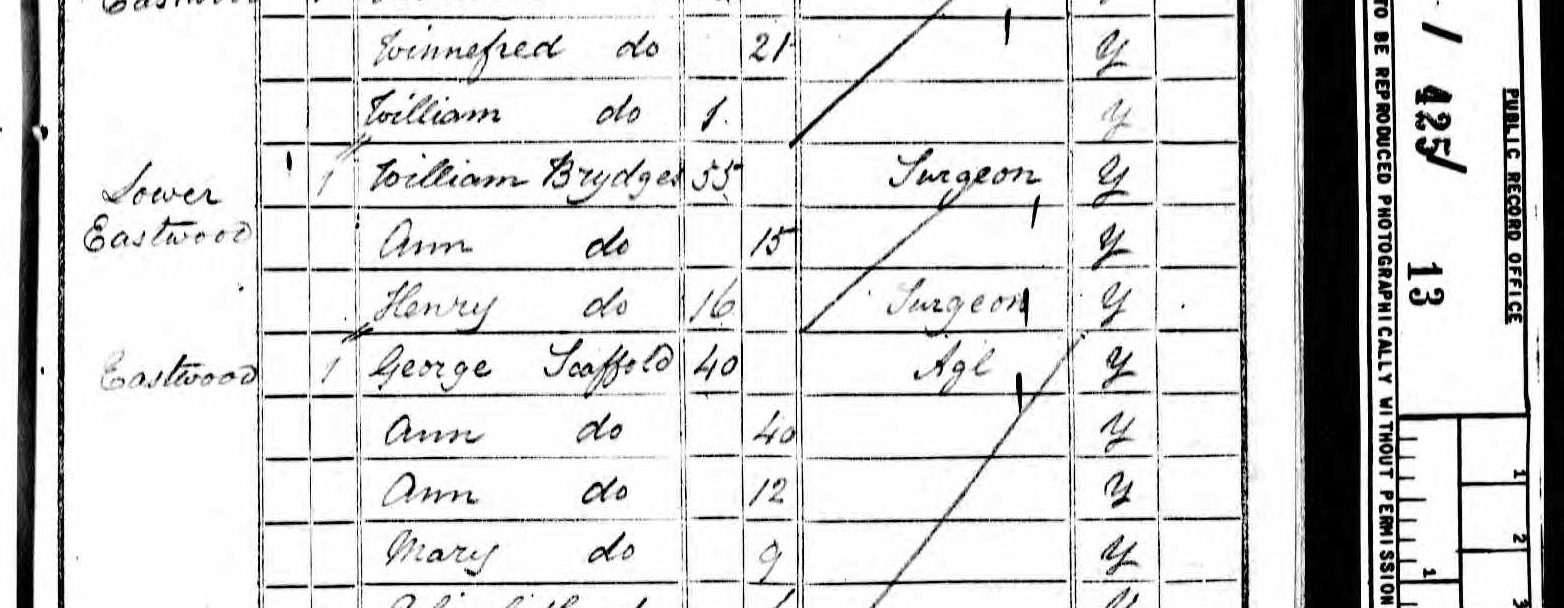
The censuses add the late chapters of his life. In June 1841 the enumerator found him at Lower Eastwood in Tarrington, written up plainly as surgeon — the primary record of his practice — with two teenagers in the house, presumably his younger children: Henry, sixteen, himself already styled surgeon, and Ann, fifteen. Alice was not in the household. By 1851 he was a widower, farming twenty acres at the same address with two young servants and two labourers, the return now styling him farmer, not doctor. The one oddity is the age — the 1841 clerk wrote fifty-five for a man of sixty-one — but the address and the name carry the identification.

He was not even the family circle’s first physician. Back in the seventeenth century a Brydges daughter, Elizabeth — first the widow of John Dannett of Old Court, Bosbury — had married Dr Bridstock Harford of Hereford, described by the county historians as an eminent physician, whose descendants have already crossed this history: from the Harfords descends Sir Harford Jones-Brydges, whose taking of the name in 1826 was the occasion, in Chapter Two, of the College of Arms proving the family’s true coat. Medicine, it seems, ran along this valley.
The clue in a middle name · Ledbury, 1807
The doctor’s son was born on 27 May 1807 in the market town of Ledbury, four miles from Colwall, and he was christened Joseph Halford Brydges. In the nineteenth century, a middle name like that is rarely decoration. It is a record. Parents gave a son his mother’s maiden surname to bind two families together on the baptismal page — and Joseph Halford’s mother was Alice Halford, born about 1781.
This is the kind of detail genealogists live for, because it cannot easily be faked and it travels. Wherever Joseph Halford Brydges went — and he went to London, dying in Middlesex in 1874 — he carried his mother’s family in his own name.
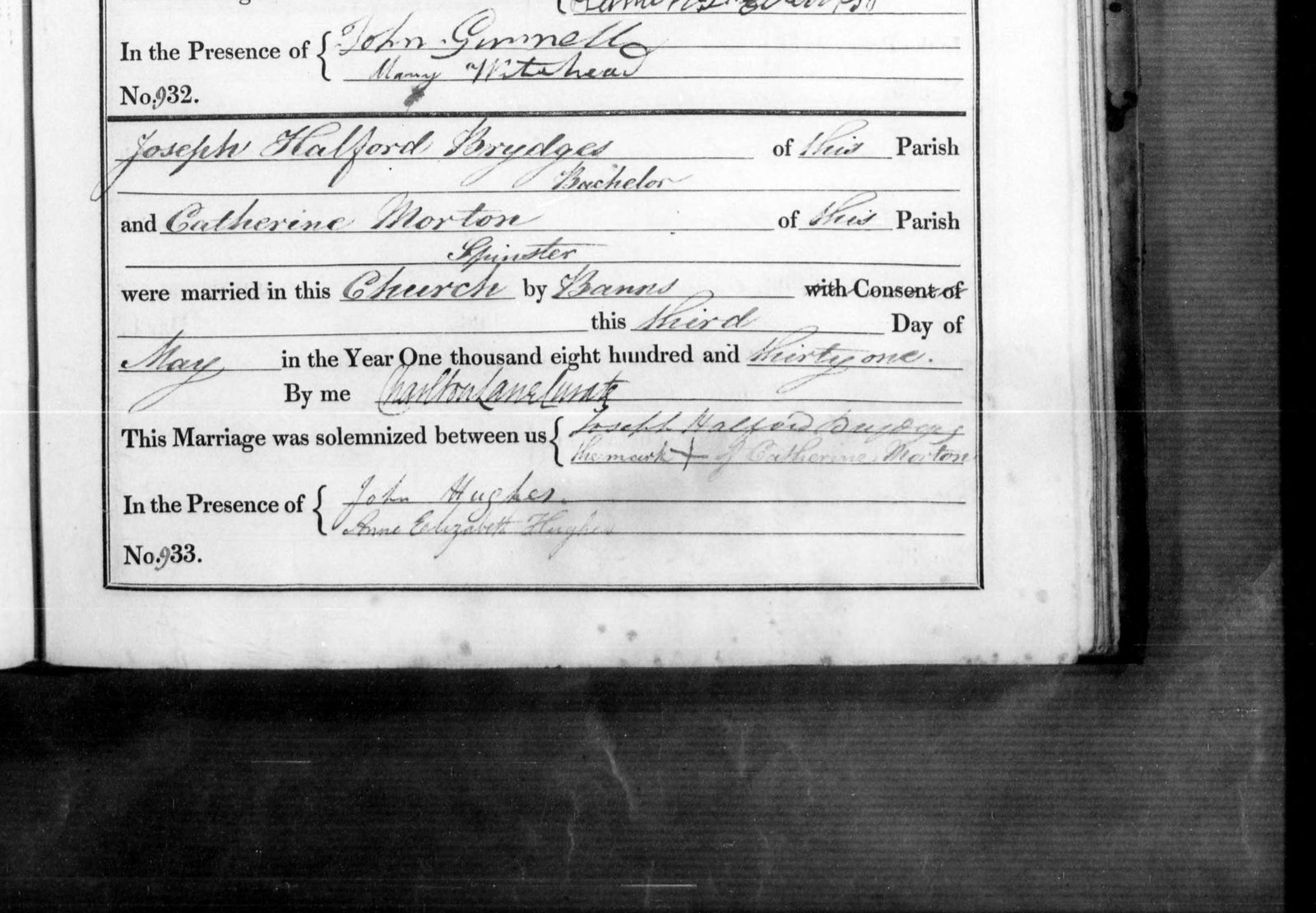
The move came early in his manhood. On 3 May 1831, at St Mary’s Lambeth, “Joseph Halford Brydges, bachelor, of this parish” married Catherine Morton, spinster, by banns; he signed the register in a clear hand, and Catherine made her mark. By 1842, when their son Joseph was born in Southwark, the line was a London family.
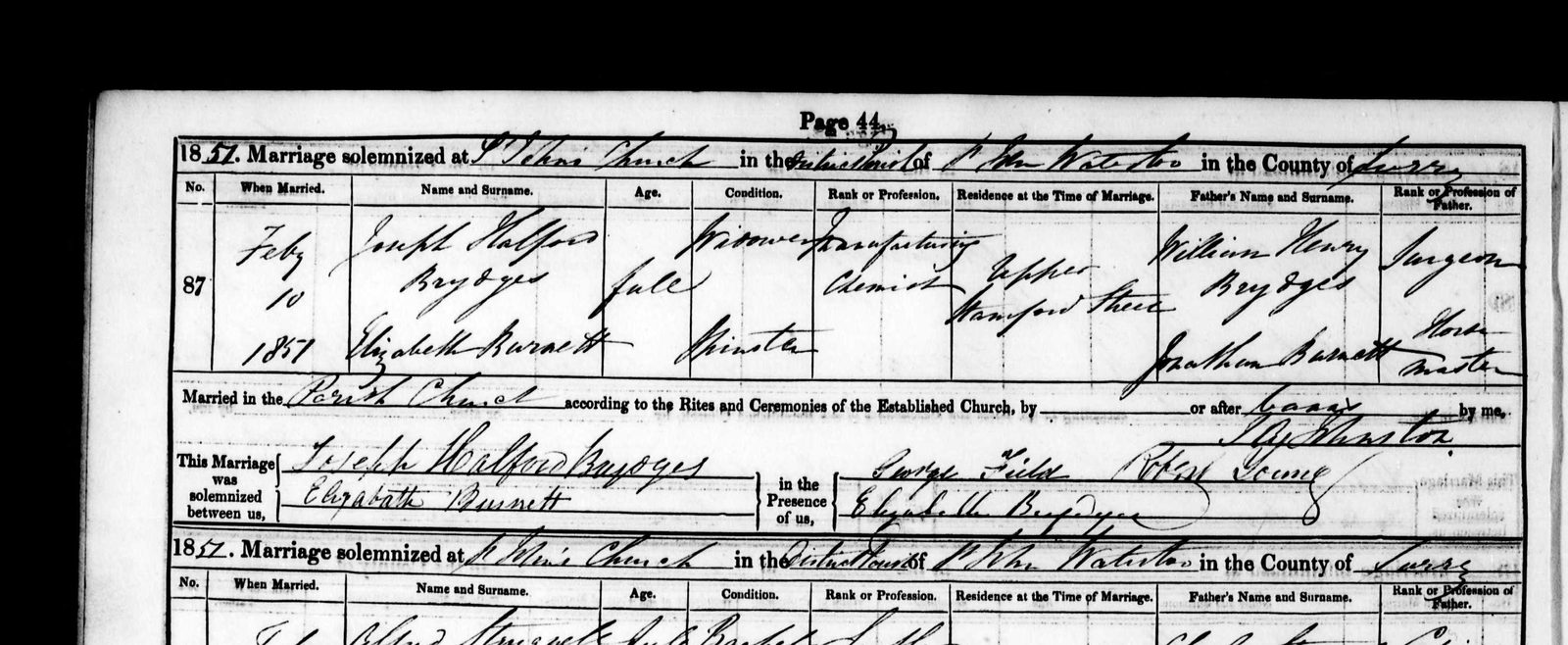
Catherine died in 1847, and on 10 February 1851, at St John’s church, Waterloo, “Joseph Halford Brydges, widower”, a manufacturing chemist of Upper Stamford Street, married again: Elizabeth Barnett, spinster. The register asks a question the census never did — the father’s name and profession — and Joseph Halford’s answer closes the link this chapter opened: “William Henry Brydges, Surgeon”. The London chemist named the Colwall doctor as his father, in a public register, in his own lifetime.
Smoke and river · London, 1842–1939
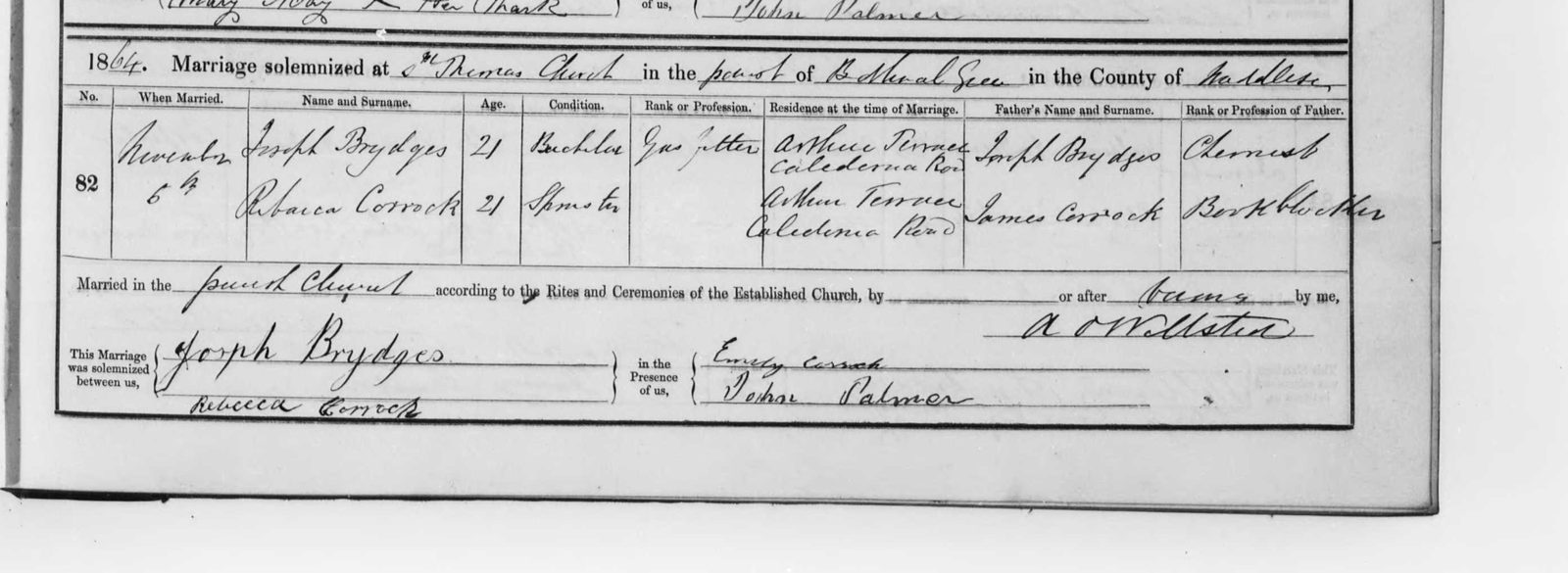
On 6 November 1864, at St Thomas’s church, Bethnal Green, Joseph Brydges, a gas fitter of twenty-one, married Rebacca Corrock, twenty-one, daughter of James Corrock, a boot clicker; bride and groom both gave their address as Arthur Terrace, Caledonian Road. The register’s father column for the groom reads “Joseph Brydges — Chemist”: the manufacturing chemist of the Waterloo register. The second London join in the chain closes exactly as the first did — a son naming his father on his wedding day.
Between 1840 and 1880 London’s population roughly doubled as railways, docks and workshops drew families in from the counties. For this family the break is documented: Richard Brydges of Old Colwall died in January 1813 and the estate was sold, passing to James Martin in 1827. The son born at Ledbury in 1807 grew up with the family seat gone; by 1831 he was marrying in Lambeth, and by 1842 the next generation was being born in Southwark. What the family did once there the records now say plainly: a manufacturing chemist, then a gas fitter, then a smith and fitter in iron work, with the women of the house tailoresses. The districts are well described too: Somers Town in 1881 was among London’s most crowded quarters, streets being progressively demolished for the railway goods yards, households commonly a family to a room; Joseph’s Poplar was the dockside east, where casual labour was hired by the half-day at the dock gates. That is the world the records place them in.
In April 1881 the census found the family in Bow, in the East End of London: Joseph Brydges, a gas fitter born about 1842 — Southwark by the family record, Lambeth by the census — his wife Rebacca Corrock, born about 1843 in Bermondsey, and four children: Louisa, twelve; Henry, seven; Florence, three; and William, aged one, born at Old Ford.
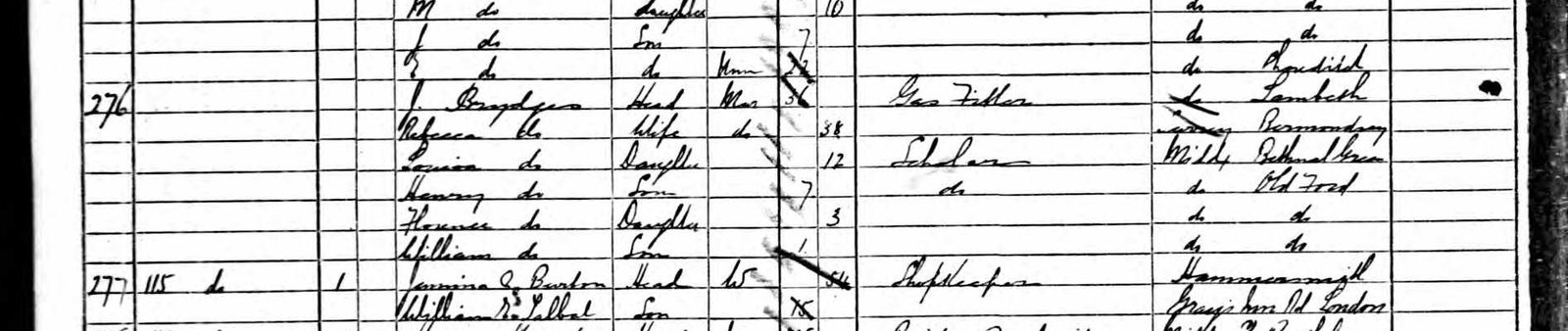
That youngest name once looked like the real puzzle of the London years, and a single index entry has now largely solved it. The family record says William Charles Brydges was born on 14 October 1881 at 22 George Street in Somers Town, between the three great railway stations, Euston, St Pancras and King’s Cross — yet a William already appears in the Bow household in April 1881, aged one, born at Old Ford, and the censuses of his childhood carry ages that fit that elder birth. The General Register Office index settles the registration: a William Charles Brydges was registered in the Pancras district — Somers Town’s own district — in the last quarter of 1881 (vol. 1b, p. 90), squarely matching the family record, and matching his own 1911 return, which gives George Street, off the Hampstead Road. The most probable reading of the whole record is that the William of April 1881 was an elder brother, lost young, and that the name was given again to the boy born that October — a common practice of the age. His death entry, and the birth certificate itself, would close the question entirely; the census ages that run a year ahead are noted, and outweighed.
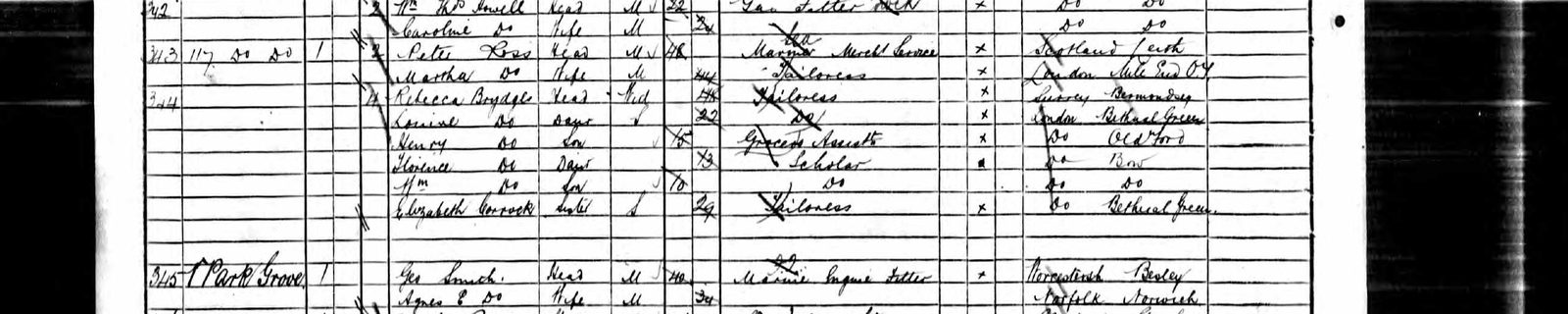
Joseph died at Poplar in April 1886, aged about forty-four, and the censuses follow Rebacca through widowhood: in 1891 a tailoress at Plaistow, her unmarried sister Elizabeth Corrock — a tailoress too — in the house and four children still at home; in 1901, at 117 East Road, West Ham, with Henry a dock labourer, William a pawnbroker’s assistant and Florence a tailoress.

By 1911 William Charles had crossed London to Fulham. His census return of that spring — signed in his own hand — shows him at 130 Townmead Road, aged thirty, a smith and fitter in iron work, nine years married to Annie Louisa, with five children: Annie Louisa, William Charles, John James — aged four — Lily Hannah, and Violet Mary, five months old. The 1939 Register completes the run a few streets away, at 34 Hamble Street: John James, a pipe fitter and plumber born 19 March 1907, with his wife Annie L., born 6 October 1913. William Charles died at Leamington on 19 February 1967, aged eighty-five; John James’s daughter Ann, born in 1937, is the last of this descent to bear the name; her brothers carried it on.

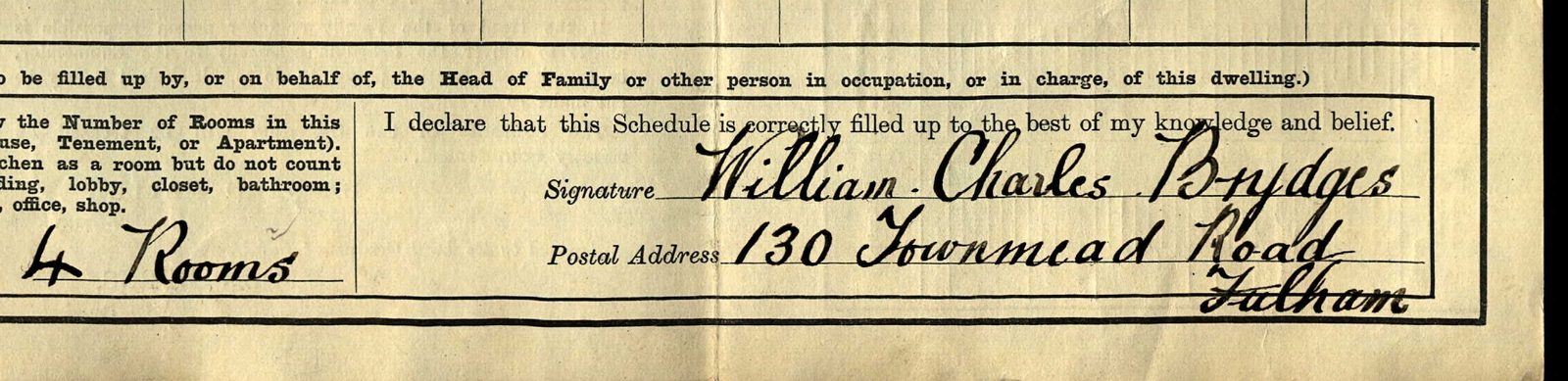
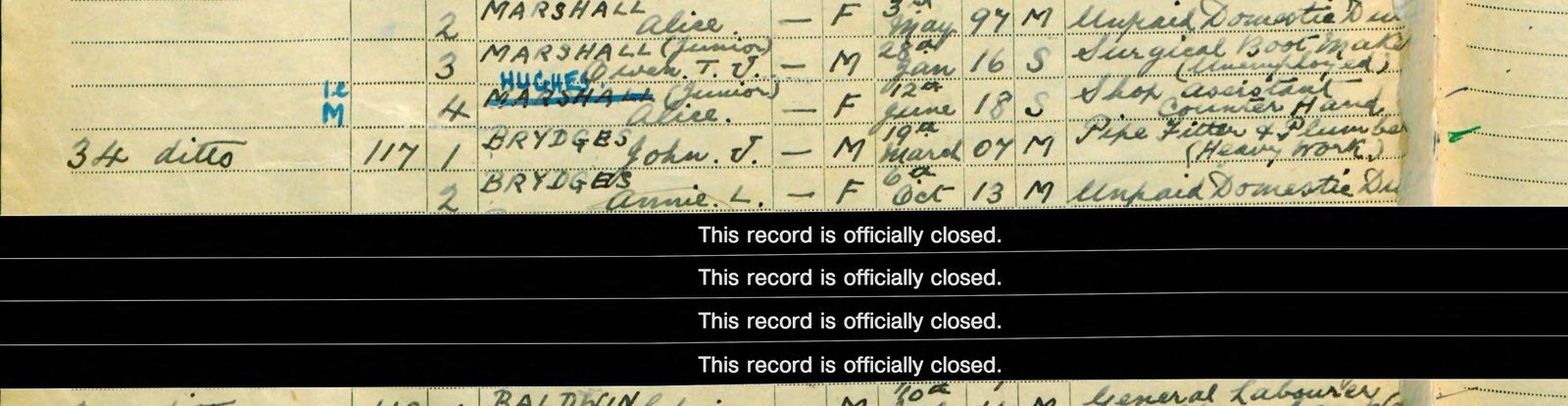
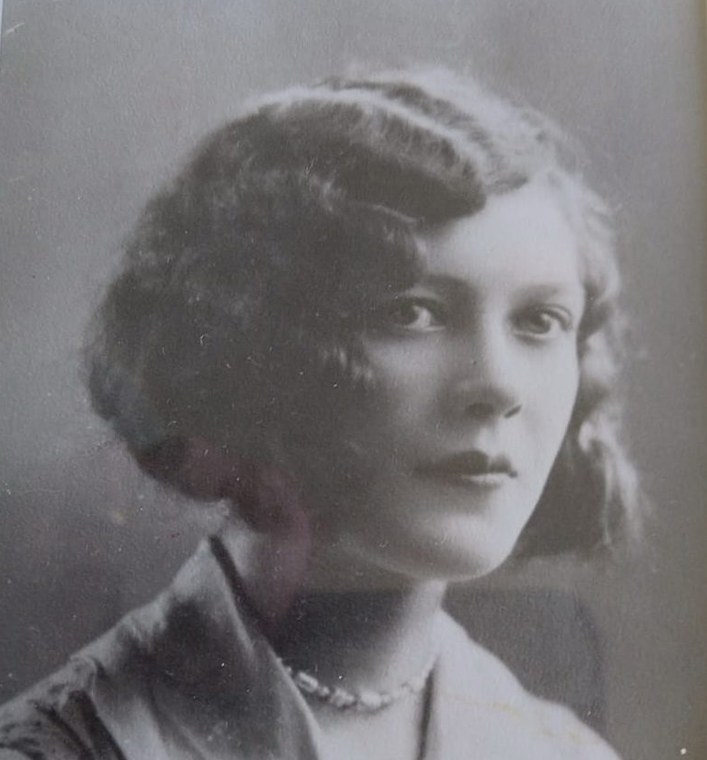
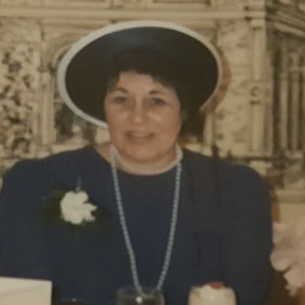
And here the record changes character. Every generation before this one is a name in a register, a signature on a will, a line cut in stone. These four are the first the family can look at.
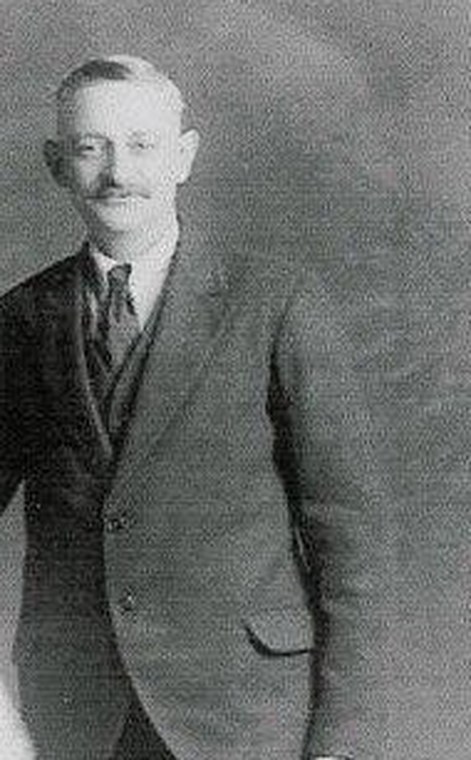
smith & fitter, of Fulham
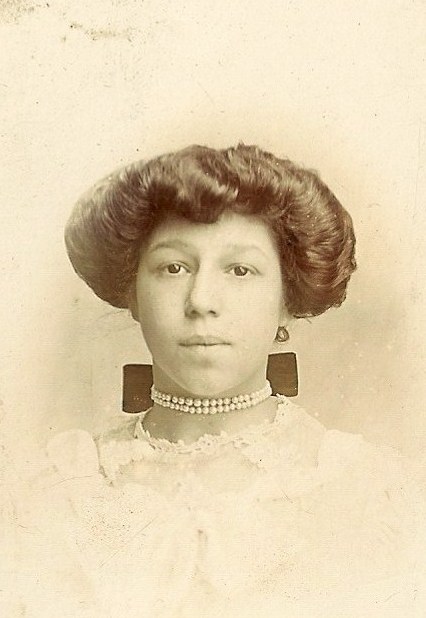
his wife, married c. 1902
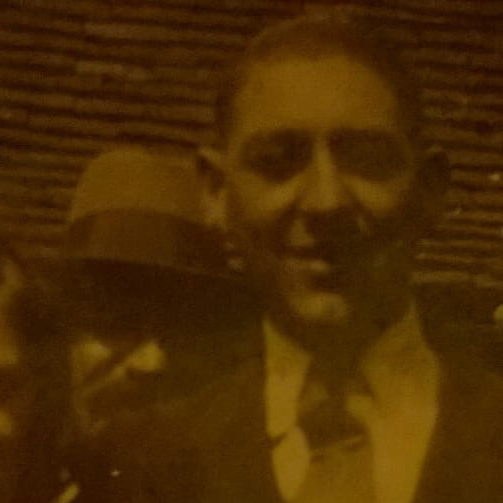
pipe fitter & plumber
his wife
What remains to be found
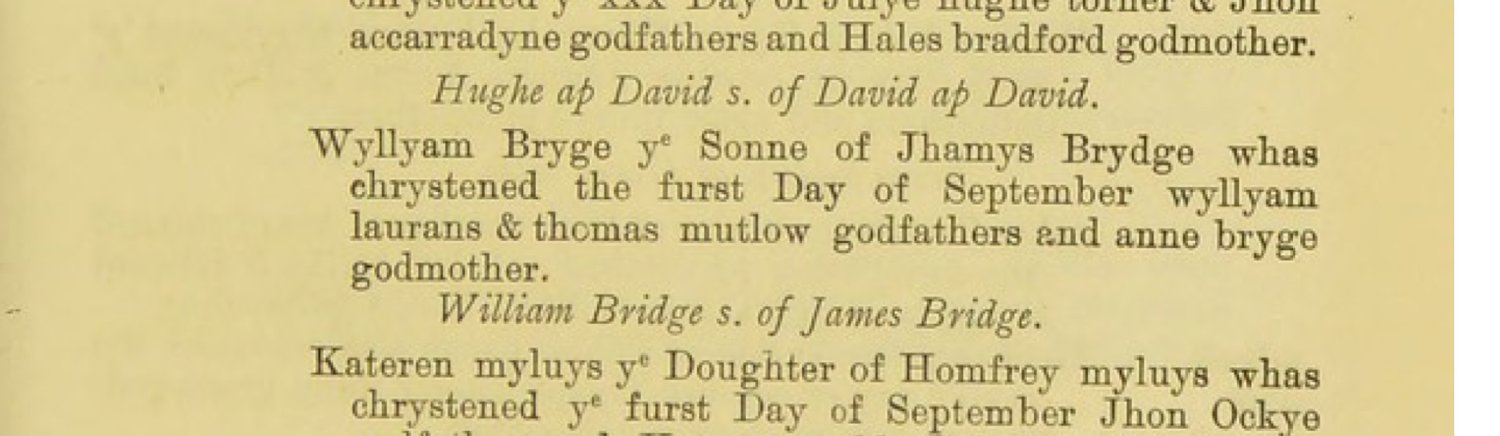
Honest family history says what it does not know, and says when its proofs are provisional. The line is now evidenced at every generation, but the file of open questions has grown with the research. The first is verification: the 1779 baptism and the burials of 1813, 1827, 1829 and 1863 rest on a volunteer’s transcription of the Colwall registers, and the formal citations are the originals at Herefordshire Archives or their images online — a morning’s work to sight. The second is the generation above the founder — and the printed Ledbury registers, now read in the Parish Register Society’s edition of 1899, have carried it to the edge of proof. The entries run in sequence: “Jhamys Bryge and Jane Laurans” married on 31 October 1557; a son James, christened 28 March 1559, buried three weeks later; and then, on 1 September 1560, “Wyllyam Bryge yᵉ Sonne of Jhamys Brydge”, christened with “wyllyam laurans & thomas mutlow godfathers” — the eldest surviving son, with his mother’s family and the Mutlows already standing at the font. The register also corrects the index that first raised this lead: James remarried the widow Anne Mutlow on 26 November 1571, not 1570 — which means the Jane Bridge buried at Bosbury on 22 May 1571 is, in all likelihood, Jane the first wife, dead at Bosbury six months before her widower remarried. Set the whole file together — the register naming William as James’s son; the widow’s 1603 account naming her stepson William Bridge as administrator of James’s Bosbury estate; William of Upleadon’s own overseer “my cousin Thomas Lawrence, Esquire” (his mother was a Laurans, and Edward Lawrence, gentleman, of Ledbury, left a son and heir Thomas); his nephew Anthony Barkeley (James’s daughter Catherine married a Bartley); and no other adult William Bridge visible in Bosbury around 1600 — and the identification stands proven in all but the final formality: no single record yet writes “William of Upleadon, son of James” in one line. The original probate bundle at Herefordshire Archives (A81/II/84) is the last place such a line might be found. The third is enrichment: the will of Richard Brydges, proved in or after January 1813, should name all his children and divide what remained; beside it sit the estate sale papers of 1813–1827, whose abstract of title will recite the family’s ownership deed by deed. The fourth is the grant of arms itself: Foster’s Grantees of Arms indexes it to British Library Harleian MS 6179, folio 19v, where the record of the grant to William Bridge of Bosbury can be read — blazon, crest, date, and perhaps his parentage. Behind these sit the marriages, each traceable through marriage bonds and the county Visitations: Joan Hill, recorded daughter and heir of Richard Hill of Downend — if of the armigerous Hills, a quartering vested in every descendant, but unproven — then Ursula Drew of Dymock, Elizabeth Dalton of Pall Mall, and Sarah King. The 1820s investigation papers at the College of Arms complete the set. And one document is missing from the family’s own hands: the cherished scroll of pedigree my grandmother knew. Finding it, and reading which descent it draws, would close the circle this history opened.


What will not be found is the Chandos descent. That door was closed by professionals in 1683, and again in the 1820s, and the closing is itself part of the family’s story.
Four centuries and more
Stand back, and the documented shape of it is this. A Tudor gentleman at Upleadon. His widow, carved kneeling at her prayers at Mordiford. A son who lived past eighty. A grandson whose will and death share a single date. A Sheriff of Herefordshire. A testatrix who endowed bread for the widows of two parishes, a school for Ledbury, and a life annuity for her servant George Thomas. A doctor carried to the font at Colwall in 1779 and buried from the same church in 1863. A move to London by 1831, traced through Lambeth, Bow, West Ham and Fulham. A charity, signed into being on a deathbed in 1704, still handing out St Thomas’ day vouchers in 1984. And a spelling, adopted in the 1660s and questioned by a herald in 1683, carried unchanged to Ann Brydges, born in 1937, the last of this descent to bear it.
The family legend claimed noble Chandos blood, and the record refutes it. What the record puts in its place is more durable: tombs at Bosbury and Mordiford, wills at Kew, an entry in the College of Arms, a Lancaster Herald’s book, a receipt in Richard’s own hand, and registers running from Colwall to Fulham — every generation of the direct line now standing on a document. Four centuries and more, in stone, ink and parchment.